
One place to run the work.
An internal workspace for requests, assignments, decisions, and the next step.
Build · Illustrative scenario
A proposed workflow, not a deployed client system. No client outcomes or savings are claimed.
All examplesThe problem.
A team coordinates service requests through email threads and spreadsheets. Everyone can see their own tasks, but finding the current owner or the reason for a decision means asking around. Standard tools do not match the way requests move through the operation.
The proposed approach.
Build a purpose-made application around the request lifecycle. Keep ownership and status explicit, validate required information, and give the team a shared record of each decision. Add AI assistance only to the parts that benefit from interpretation.
How the work changes.
Before
- Requests arrive in separate inboxes.
- Someone copies the details into a spreadsheet.
- The team chases ownership and missing information.
- Progress is reconstructed for the weekly update.
After
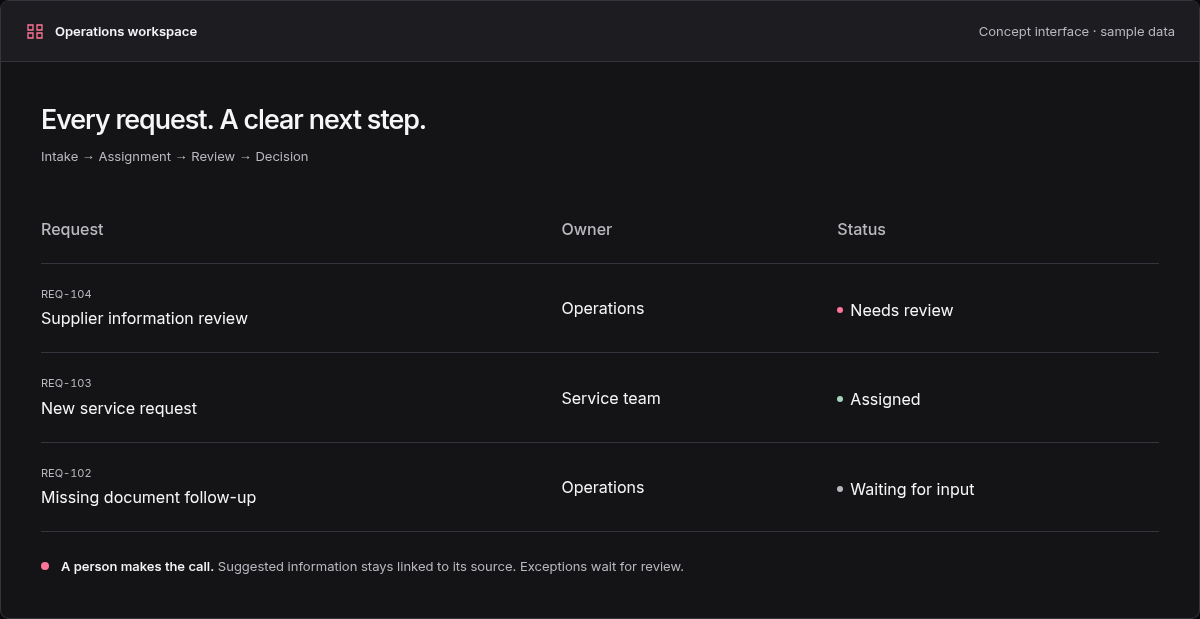
- A shared intake captures the required details.
- Rules route each request to the right owner.
- The owner reviews exceptions and records decisions.
- The workspace shows status and the next action.
What we would build.
- An intake and request workspace shaped around the team’s process.
- Assignment, review, and exception handling with clear permissions.
- An activity record and reporting based on workflow events.
Where people
stay in control.
- People approve consequential decisions.
- Access is limited by role and the scope of each task.
- AI suggestions remain distinguishable from approved decisions.
What to measure.
Capture the current process first, then compare the pilot against it using the same definitions and representative work.
- Time spent locating status and ownership.
- Number of manual handoffs per request.
- Cycle time and requests requiring rework.
These are evaluation measures. Results would depend on the actual workflow, its users, and the implementation.
Explore custom ai applications & decision systemsHave a challenge
worth solving?
A process that should run better. An AI initiative that needs to become operational. A tool your business wishes existed.
Tell us what you're trying to accomplish. We'll help determine what's possible, what makes sense to build, and where the investment can create value.